

Abbey of Sant’Andrea di Borzone and the Benedictine Monastery
The Abbey Overlooking Eastern Liguria
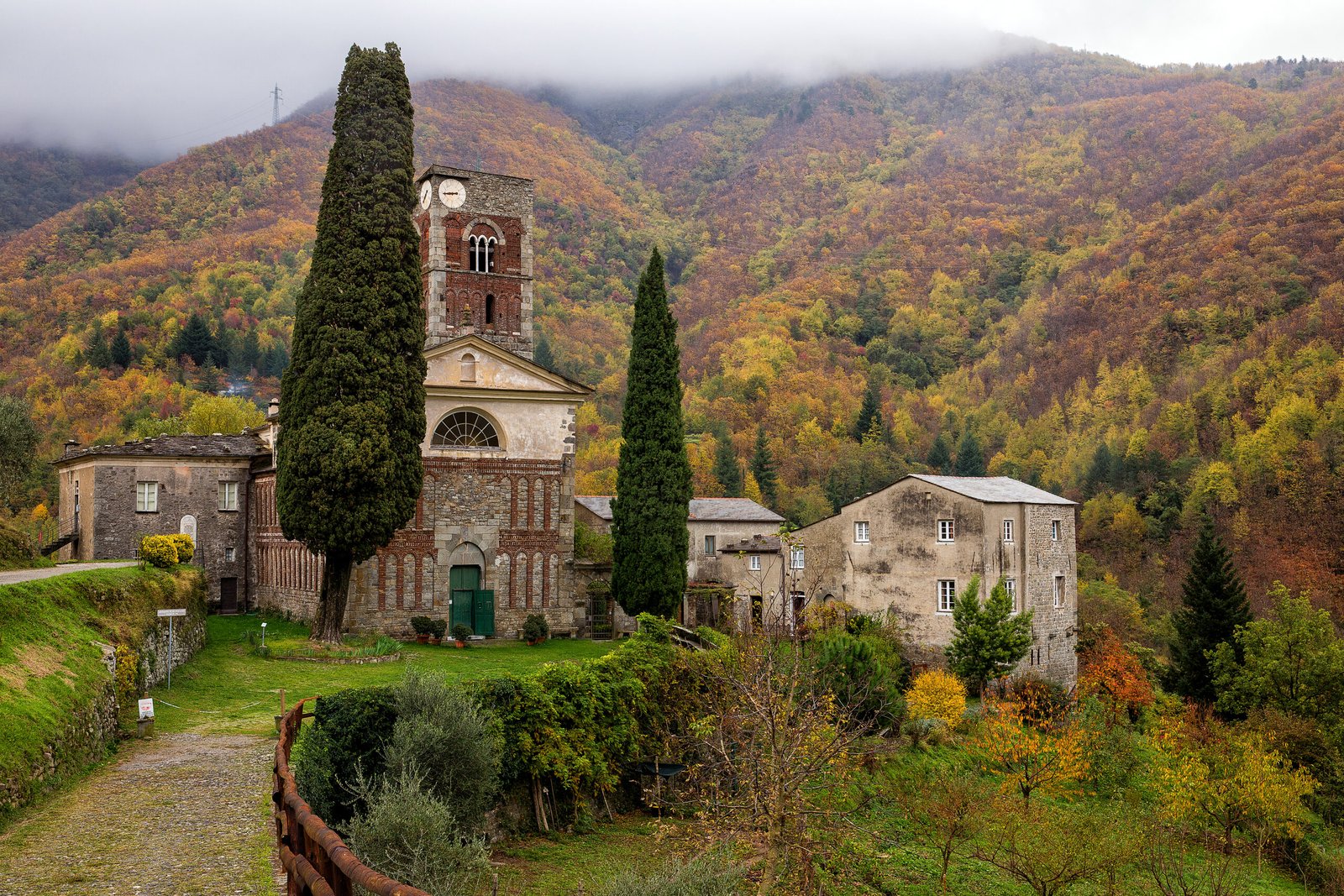
The Abbey of Borzone is the most important historical and artistic monument in the inland area of eastern Liguria. Built in a commanding position on a large terrace, the abbey defines the landscape with the imposing mass of its bell tower, which rises among the compact volumes of the church and the conventual buildings. Its monumental presence is not only architectural but also symbolic: for centuries it has served as both a visual and spiritual landmark for the surrounding territory.
Ancient Roots and Foundational Hypotheses
The origins of the complex predate written records and remain shrouded in a fascinating historical uncertainty. Scholarly hypotheses range from a late Roman castrense origin to a Bobbio foundation dating to the 7th century or a Lombard foundation. Some scholars identify in the famous act of 17 June 1184, through which the Archbishop of Genoa entrusted the cenobium to the Auvergnat monks of La Chaise-Dieu, the character of a true ex novo foundation, marking a decisive turning point in the abbey’s history.
The Golden Age under the Ravaschieri Family
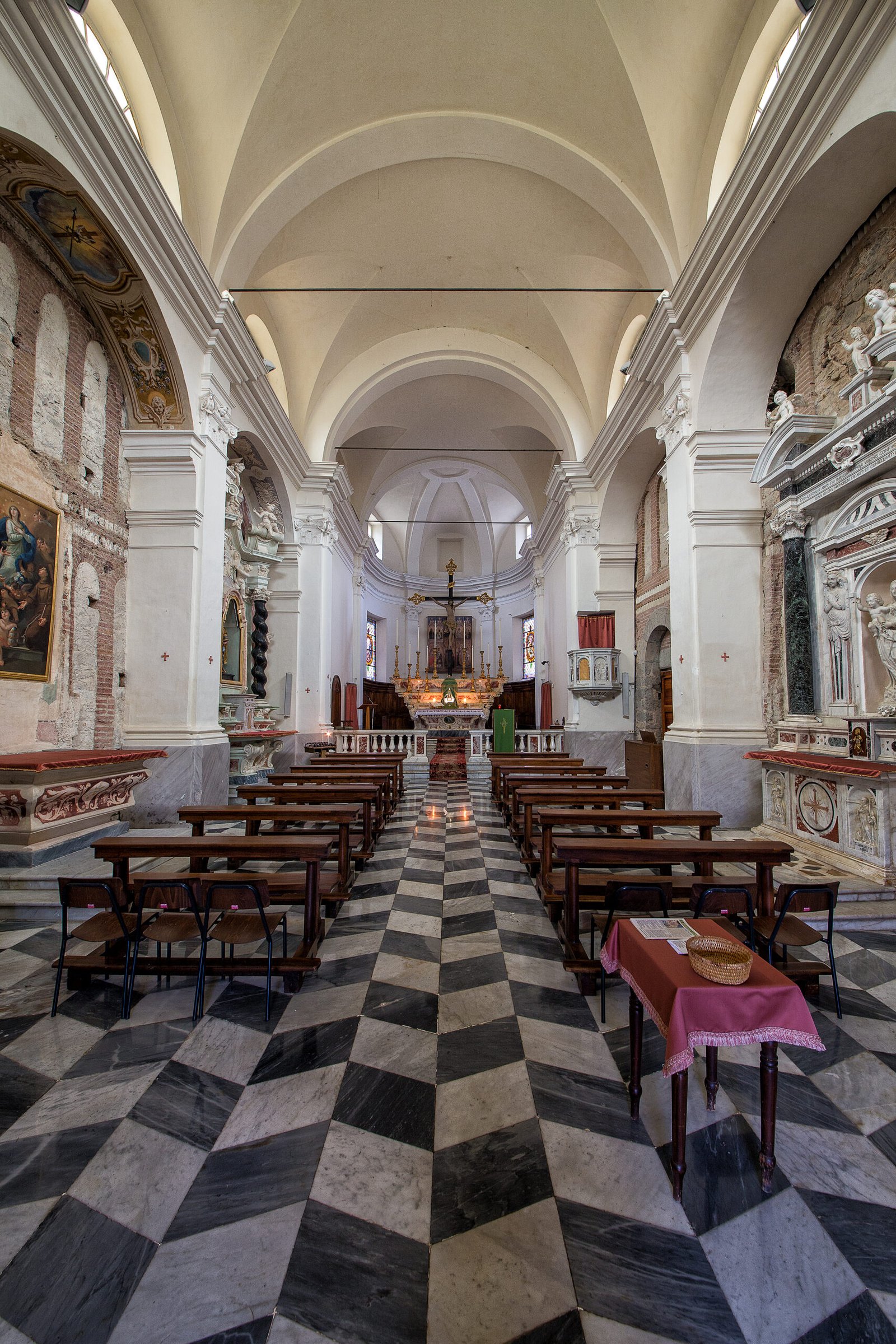
Under the patronage of the Ravaschieri family, the abbey experienced its period of greatest splendor, exercising important functions of cura animarum and serving as a baptistery. During this phase of renewal, Abbot Alessandro Ravaschieri commissioned in 1484 the celebrated polyptych by Giovanni Barbagelata, a masterpiece of the Ligurian Renaissance now preserved in Chiavari. The work became a symbol of the community’s return to the cenobium after the unrest that had marked the 15th century.
A Unique Architectural Identity
From an architectural point of view, the abbey church is a true unicum due to its distinctive masonry facing. The façades appear “designed” like a tapestry, featuring a double order of panels defined by blind arches and brick cornices with a cog-tooth pattern. The archaic nature of the design is confirmed by the primitive nave, devoid of lateral windows, since the staggered decoration made the opening of wall apertures impossible. The bell tower, standing 25 meters high, owes its imposing character to the base of large rusticated ashlar blocks, a structural system that continues into the elevation of 1244 commissioned by Abbot Gerardo, before giving way to brickwork in the bell chamber.
The Abbey Complex Between Sacred and Daily Life
In addition to the sacred building, the complex is composed of other highly significant structures. The southern building, now used as the rectory, preserves an intact medieval cellar; its walls display a regular arrangement of large sandstone blocks, worked with point chisel and hammer, closely comparable to 12th-century French Carthusian structures. A second building, located to the east and now used as a farmhouse, completes the abbey nucleus together with the remains of the cloister. These buildings retain traces of ancient monastic and military structures, bearing witness to a site capable of blending diverse architectural cultures into a coherent monumental organism.
Sources
Geoportale Regione Liguria – Architetture
Trekking and cycling routes that may interest you
Itineraries of different durations and suitable for every taste and level of preparation, to discover the most beautiful and evocative places and panoramas of the Ligurian Tigullio.




Local experiences that might interest you
Let yourself be guided and be surprised by the hidden treasures that the Ligurian Tigullio area is capable of offering you in every season.

Sport
Hiking routes, climbing, mountain biking and much more… Choose the sport in contact with nature that’s right for you!

Culture
Shows, Theatre, Music, Food and Wine, Reading… Experience the cultural and artistic proposals, immersed in the Ligurian landscape.

Nature
Geology, bird watching, nature engineering and other initiatives, to cultivate awareness and responsibility for environmental issues.
More heritage that may interest you
Catalog of the tangible and intangible heritage, a precious resource of the Tigullio for community building and local development.



Join us!
Preserve the history and traditions of the Ligurian Tigullio area and keep them alive for future generations.